Educational institutions and teachers should approach gifted students through experimentation, innovation, and creativity. The spirit of STEM education (Science, Technology, Engineering, and Mathematics) must also remain human-centric, emphasized Prof. Manabu Sumida, Faculty of Education and Director, Centre for Gifted Education and Talent Development (EU-GATE), Ehime University, Matsuyama, Japan.
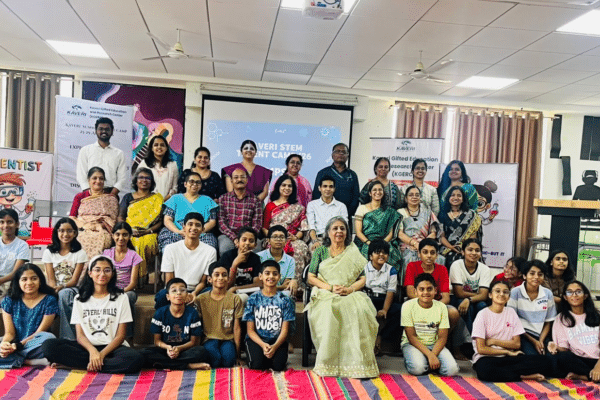
He was speaking at a special program organized to mark the completion of 12 years of the Kaveri Gifted Education and Research Center (KGERC). The event was held at the Kannada Sangha Campus, Ganesh Nagar, Erandwane.
Prof. Sumida shared insights into gifted education practices and methodologies in Japan. He highlighted that science is not limited to objective facts and research findings but is also a part of a broader scientific culture encompassing history, language, and a global perspective. He noted that Japan has successfully integrated global perspectives with its traditional knowledge systems, giving science a unique national character.
He further explained that while the Western perspective views nature objectively and analytically, the Japanese perspective considers humans as an integral part of nature. “Science is universal and not the heritage of any one country; otherwise, Japan would not have produced such a large number of Nobel laureates,” he added.
Sharing his experience with Japan’s Kids Academy, which focuses on STEAM education, Prof. Sumida explained that gifted students are engaged through activity-based and experimental learning alongside textbooks from as early as five years of age. The academy emphasizes innovation, creativity, observation, attentiveness, and research-oriented thinking. He also appreciated the remarkable work being carried out by KGERC in this field.
Among the dignitaries present were Takashi Kawamoto, Vice Principal of the Special Needs Education School affiliated with Ehime University